
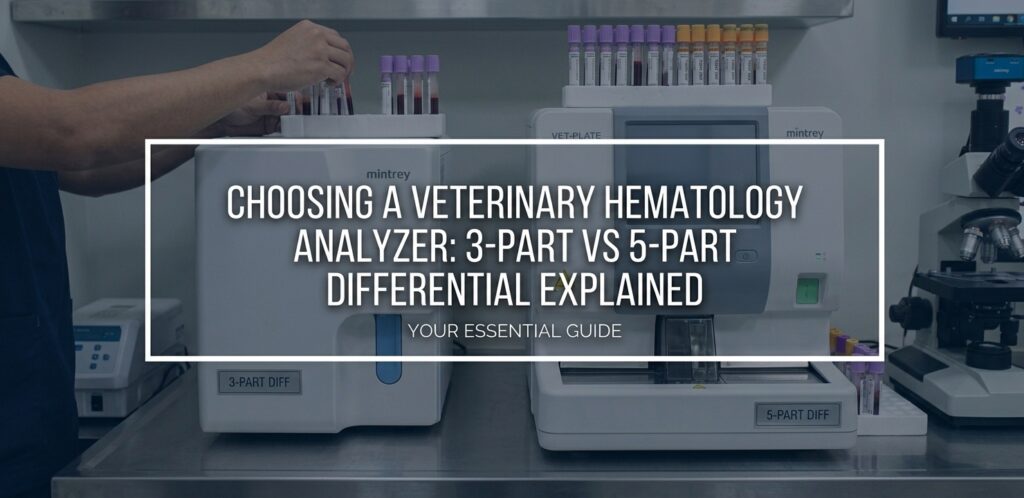
Choosing a veterinary hematology analyzer depends on the types of cases your clinic handles. A 3-part differential groups white blood cells into three categories, while a 5-part differential identifies neutrophils, lymphocytes, monocytes, eosinophils, and basophils separately. Both are useful for blood testing, although a 5-part analyzer gives veterinarians a closer look at changes in white blood cells.
For clinics that mostly handle routine checkups, a basic analyzer may be enough. Those treating more complicated cases may need more detailed results. It’s also worth looking at how often you’ll use the machine, the amount of blood required, reagent expenses, and maintenance support before buying.
What does a Veterinary CBC Machine do?
A Veterinary CBC (Complete Blood Count) machine looks at blood samples to provide information on the three main cell types present; red blood cells, white blood cells and platelets. This allows vets to get an understanding of the patient’s condition and if further testing is required.
Red blood cell values can provide information on hemoglobin, hematocrit and other indices. White blood cell counts can provide information on inflammatory and other disease processes. Platelet values can help provide information on normal clotting factors.
If a dog comes into practice showing signs of weakness, fever or loss of appetite then a CBC can provide helpful information. However, if values are abnormal this does not necessarily indicate a specific disease. The values need to be looked at alongside the history, signs and other findings. Blood smears should still be performed if there are any abnormal results.
What is the difference between a 3-part and 5-part differential?
The main difference between a 3-part and 5-part differential is the way the white blood cells are separated. A typical 3-part differential will provide information on lymphocytes, granulocytes and an intermediate/mixed cell type. This will give a general overview of the white blood cells.
A 5-part differential will provide individual values for neutrophils, lymphocytes, monocytes, eosinophils and basophils. This can help give more detailed information on patients suspected of having inflammatory, allergic, parasitic or other conditions.
However, it is important to note that both options shouldn’t be used as an alternative to looking at cells under the microscope. Automated systems can struggle to identify abnormal cells and some cell types can be difficult to quantify. Consider what information is needed by your vet, the validated performance and complexity of cases you typically receive.
3-Part vs 5-Part Differential: Quick Comparison
Feature | 3-Part Differential | 5-Part Differential |
White blood cell categories | 3 groups | 5 individual types |
Lymphocytes | Reported | Reported |
Neutrophils | Usually included within granulocytes | Separately reported |
Monocytes | Usually included in mixed cells | Separately reported |
Eosinophils | Usually grouped | Separately reported |
Basophils | Usually grouped | Separately reported |
Clinical detail | General white cell distribution | More detailed differential |
Typical application | Routine screening and basic testing | More detailed hematology evaluation |
Blood smear review | Still required when indicated | Still required when indicated |
Purchasing consideration | Simpler differential requirements | Additional classification capabilities |
Note – Different manufacturers will provide different groupings. Just because it provides a 5-part result doesn’t mean that all cell types will be identified from every sample/species.
Which veterinary clinics should purchase a 5-part Analyzer?
Depending on the size of the practice it may not be necessary to have a detailed hematology analyzer. If a practice is mainly vaccinating and providing wellness consultations and screening then a simple differential may be enough to cover most cases. Especially if they can refer to more specialised blood tests.
A 5-part analyzer may be more appealing if the practice regularly deals with complex cases, inpatient cases or animals requiring regular lab monitoring. Having individual white blood cell counts can provide further information when looking at certain inflammatory conditions, possible parasitic disease or changes during treatment.
However, having more parameters doesn’t necessarily mean better decisions will be made. It is important to understand the limitations of the analyzer. You will need to decide if further tests are required. Have a look at what CBC’s you are currently carrying out, how many samples you are referring to and what specific information you require that you can’t currently get.
What makes the Mindray BC-30 Vet special?
The Mindray BC-30 Vet is designed to provide a compact option for veterinary labs offering routine CBC. This machine is classed as a 4-part differential analyzer according to the manufacturers official specifications. This provides 23 parameters, including individual eosinophils.
This machine offers open vials, 8.4 inch touch screen and a large memory for 100,000 results. This machine can provide 38 tests per hour according to Mindray. This can be appealing for practices wanting more information without upgrading to a more advanced machine.
In the Philippines it is important to consider space on your counters, reagents available, what environment the machine will be used in and what maintenance will be provided. Request a demo and ensure the machine supports the correct species. Some species were listed as coming soon in previous manufacturer documentation.
Mindray BC-30 Vet – Key Features
- 4-part differential
- Up to 38 tests per hour
- 8.4inch Touch Screen
- Open vials
What does the Mindray BC-60R Vet offer?
This machine is designed to provide more advanced hematology testing for veterinary practices. This machine is classed as a 6-part differential analyzer according to Mindray. This machine uses scattering light and fluorescence to analyse white blood cells.
One of the key features of this machine is that it uses the Mindray SF-Cube veterinary hematology analysis platform. This helps to provide multi-dimensional information on the cells. The manufacturer also mentions reticulocyte analysis and the ability to identify some suspected abnormal cells.
This may be useful for veterinary hospitals/labs dealing with complex blood samples. However, it is important to consider what species have been validated, training required and quality assurance in the lab. Ensure the machine has current performance data, supported tests and a demo.
Mindray BC-60R Vet – Key Features
- 6-part differential
- SF-Cube
- Fluorescence
- Reticulocyte
Comparison of Mindray Veterinary Hematology Analyzers
It can be useful to look past the number of differentials and consider what each machine is designed for. The BC-30 Vet, BC-5000 Vet and BC-60R Vet all have different testing requirements. This is why it is important to look at individual machine specs.
The BC-5000 Vet may be useful for labs looking for a 5-part differential. This machine uses laser scatter, chemical dyes and flow cytometry. It can provide up to 60 tests per hour according to Mindray. The BC-60R Vet provides a different technology.
Ask what parameters are available for your desired animal species, what sample volume is required and how it will perform with abnormal samples. Ensure it is available locally.
Mindray veterinary analyzer comparison
Model | Differential | Selected manufacturer-listed features |
BC-30 Vet | 4-part | 23 parameters; 38 tests/hour under stated conditions; 8.4-inch display |
BC-5000 Vet | 5-part | Laser scatter, chemical dye, flow cytometry; up to 60 tests/hour |
BC-60R Vet | 6-part | SF-Cube technology; fluorescence analysis; reticulocyte capabilities |
Sources: BC-30 Vet, BC-5000 Vet, and BC-60R Vet. Product availability through MAN Pharma is subject to confirmation.
How does sample volume and testing speed affect my choice?
Test speed can be an important factor. However, if you aren’t carrying out many CBCs per day then a simple machine that is easy to use and not using too much reagent may be more beneficial.
Sample volume can be a big consideration. Especially if you are dealing with small animals or patients where it can be difficult to collect blood. Each machine requires a different volume of sample. Look at the manufacturers guidelines to see what the minimum sample volume required, what anticoagulant to use, mixing and handling requirements are.
Consider how long it will take to prepare samples, run quality controls, clean the machine and review any flagged samples. Instead of choosing a machine based on high throughput, see how quickly your team can carry out tests whilst maintaining good quality.
What should I know about reagents, maintenance and quality control?
When purchasing a hematology analyzer you will need to consider the ongoing requirements. This includes reagents, cleaning solutions, calibration and quality control items. Depending on the machine there may be specific requirements for storage, expiry dates and opened requirements.
Maintenance can also be an important consideration. Some analyzers will require regular cleaning and scheduled maintenance to ensure they are working correctly. Ensure you follow the manufacturers guidelines. Not all veterinary analyzers will require the same maintenance. Your staff will also need to know how to identify any warnings and what to do if any questionable results come up.
The American Society for Veterinary Clinical Pathology highlight that quality assurance and blood smears are very important for veterinary hematology. No matter how advanced your automated analyzer is, you can never fully replace professionals. Not all abnormal cell features can be identified. Having standardised procedures in your lab will help to ensure results are suitable.
What affects the price of a vet blood analyzer in the Philippines?
The price of equipment will depend on the model, differential technology, accessories included, testing capabilities and commercial agreements. If you are looking for a machine with more parameters then you will have a higher investment. Find out exactly what the difference will be by looking at current quotations.
Running costs can be an important factor. If you are only carrying out 5 samples per day then you will have different running costs compared to a veterinary hospital carrying out dozens of samples. Reagent, calibration, maintenance and possible downtime can all affect the cost per test.
Ask your supplier to provide a written breakdown of what is included in the analyzer, warranty, reagent costs and technical support. Don’t just go for the cheapest option. Usually the best value will be the machine that will meet your requirements whilst being manageable for your expected workload.
What should I ask my veterinary equipment supplier?
A demo will be a great way to get an idea of how the analyzer will work in your practice. Ask your supplier to explain how samples will be processed, what results will be shown and what will happen if the machine identifies an abnormal value.
Ask about reagents, scheduled maintenance, training and technical support. If you are outside of Metro Manila then it is important to ensure the machine will be serviced and replacement parts available. Even if the machine will do what you require it may not be convenient if you cannot easily get support or essential reagents.
Ensure you ask:
- What species, parameters, sample volume and throughput are available.
- What reagents are required, what they cost and their shelf life.
- What installation, training, warranty and scheduled maintenance is available.
- What quality control and technical support is available.
At MAN Pharma, we provide veterinary diagnostic solutions. We provide logistics, quality assurance, scheduled maintenance and ongoing training. Speak to us about what support is available.
Frequently Asked Questions About Veterinary Hematology Analyzers
Is a 5-part veterinary hematology analyzer better than a 3-part?
A 5-part analyzer will provide more detailed white blood cell differentials. However, this doesn’t mean it is the best choice for your practice. It depends on how complex your cases are, how much testing you expect to carry out, training required, performance of the machine and what your budget is.
Can a 3-part analyzer identify infections in animals?
A 3-part analyzer can identify patterns in the white blood cell count which can help investigate infections. However, it cannot identify the cause of the infection. Further examination and testing may be required.
What is the difference between the Mindray BC-30 Vet and BC-60R Vet?
The BC-30 Vet provides a 4-part differential and is designed for routine testing. The BC-60R Vet provides a 6-part differential and uses a more advanced fluorescence platform. They should not be described as 3-part and 5-part analyzers.
Which veterinary clinics will benefit from advanced hematology analyzers?
If you are dealing with complex cases, inpatients or regular CBC testing then you may benefit from having a more advanced differential. Smaller practices should consider if having more information is worth the investment and running costs.
Will a hematology analyzer replace blood smear analysis?
No. Automated analyzers will provide key numerical information but if required you will still need to carry out blood smears. Especially if there are unexpected results, abnormal cells, clumped platelets or suspected changes to blood cell morphology.
Choose a Veterinary Hematology Analyzer to suit your practice
When investing in a veterinary hematology analyzer it is important to consider what patients you have in your practice and what you require on a daily basis. If you are carrying out basic testing then a simple differential may be suitable. However, if you are dealing with complex cases then a more detailed analyzer can provide further information.
Consider what white blood cell types are available, sample handling, testing volumes, reagent costs, quality control and technical support. This will help you to choose an analyzer that will fit well into your lab.
Contact us here https://manpharma.ph/contact-us/ to enquire about our FREE Lab Upgrade Assessment.